

Hi everyone! I hope you all are having a great day.
As I have recently become a graduate student, I thought it would be good to make some content around academics, specifically around university, posting some of my experiences and advice that I feel would be useful and beneficial for students.
Some of the things I have mentioned are what I have learnt and what I wish I knew before starting university.
The content below is what I presented in a Powerpoint Presentation for some students when I mentored them in their first year. These are generic tips as I know all the students who read this may not have studied anything healthcare-related (like I did).
Nonetheless, I hope these are helpful!
01.
GENERAL ADVICE
*MONEY: get into the habit of budgeting and saving. Prioritize what you spend your money on and know where it is going. This is important, especially when living away from home as you will need to be able to pay your bills, pay for groceries and university essentials (provided they are not free) before you spend money on things that are not necessarily a priority. If that means living below your means for a period of time, then so be it!
*LIFESTYLE AND SOCIALISING: sometimes university can change your usual routine. Make sure you find time to balance your personal, social and university life so there is some structure in your life.
*KNOW WHEN YOU NEED A BREATHER: Learn to recognise when you’re getting burnt out. Find what helps you detox and relax. It can be detrimental to carry on working when you’re burnt out, as the quality of your work goes downhill. I say this because I burnt myself out at one point and it became unhealthy and stressful.
*LECTURERS: try and build a good relationship with your lecturers. It’ll make them recognize you more and build networks. ALSO, ASK QUESTIONS! Difficult work/modules don’t randomly disappear. Tackle them once you get the chance. You can’t always ‘wing’ it.
*PEER PRESSURE: don’t feel like you must go out all the time, especially during freshers. Things calm down once the season of freshers expires. If you don’t feel like going, don’t force yourself or be pressured into going. Do what makes you feel comfortable.
*WORKLOAD: Start work as soon as you get it instead of putting it off until the last minute – it’ll save a lot of hassle and stress, and you’ll have the free time to socialise afterwards. Remember ‘deadlines aren’t really deadlines’
*EXPECTATIONS: Don’t expect to be spoon-fed anything. Make sure you do your extra work/research
*COME OUT OF YOUR SHELL: it’s up to you to make it for yourself. Do things that you are afraid of doing. You only get as much as you put in (this applies to everything)
02.
TRANSITIONING
•Positive mental thinking
•Seeking help when things get difficult – university MH services (counselling), Samaritans, GP. Sidenote: this is something I did NOT do and should have done earlier.
•Sleeping – transitioning into a completely different job and social environment can throw your sleep schedule off balance. Sleeping adequately has many benefits such as:
- Improve your attention and concentration.
- Help you maintain a healthy weight.
- Strenghtens your cardiovascular system
- Keep your immune system strong. …
- Nurtures your emotional well-being
- Safefguards your Mental Health.
- Reduce your stress levels.
*Exercising – As I am sure you all are well aware exercising is always advised for many health benefits such as:
*Increase the production of endorphins, which are known to help produce positive feelings and reduce the perception of pain
*Reduces stress and anxiety
*Improves mental health
*Maintain a healthy weight
*Strengthens your bones and muscles
*Increases energy levels
*Reduces chronic health diseases
*improves brain and memory
*Helps with relaxation and sleep quality
•Time management – have a schedule, create one and be on top of it! Nothing pays off when you are ahead of things and aren’t stressing last minute! Sidenote: if you work better under pressure and last minute, this one is not for you! 😀
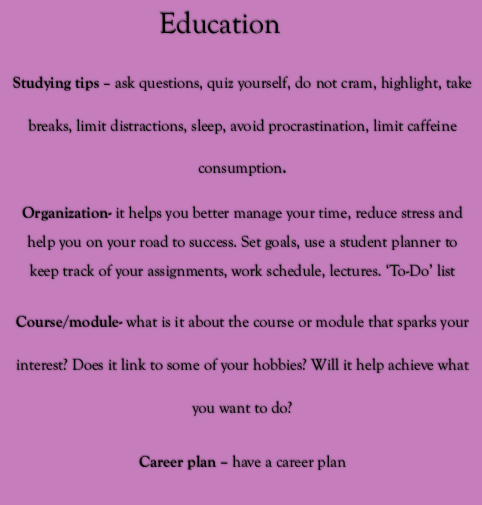
•Relaxing – make sure you take time to unwind and chill! De-stress and take a little break to pamper yourself and feel at peace. Your mind and body will thank you later.
•Surrounding yourself with positive people – nothing feels better when you are with the right and positive people around you who will support, love and guide you during your journey as an undergraduate and even as a postgraduate student. You will forever be grateful for such people in your life.
SEXUAL HEALTH
Safe sex – contraception, STIs, unplanned pregnancy… Using the appropriate form of contraception lowers the risks of unplanned pregnancies and the spread of STIs/STDs
*This website from SexWise is informative as it provides tips and useful resources and information to protect yourself and gives you all the education you need around STIs/STDs and contraception etc
CONSENT!!! – ensure that both parties understand the importance of consent, what it means and what consent looks like. You can check it out here: EVERYTHING CONSENT! (Disclaimer: contains kissing and may be inappropriate to some viewers)
*Making sure you are with friends if in a setting where you are likely to drink or smoke to ensure safety Regularly getting checked
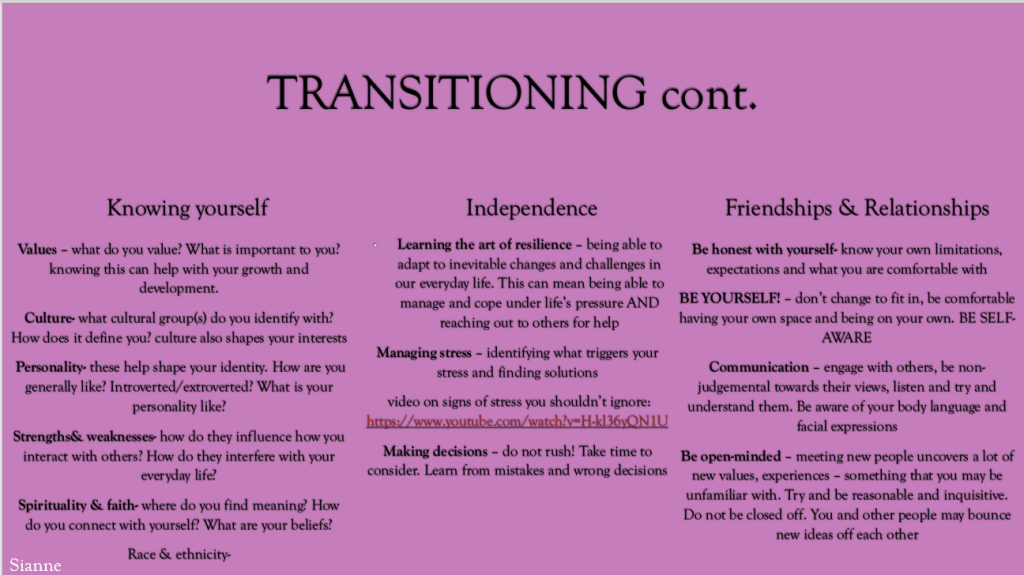
The link in the image is a video on youtube called: 6 Signs of Stress You Shouldn’t Ignore
03.
SOCIETIES/ACTIVITIES – Have Fun!
*Getting involved in sports clubs, societies, social groups.
*Finding volunteering and part-time work is a great way to meet new people and network and gain new skills.
*Enjoy your time at university and ensure you strike a healthy balance between studying and your social life. You don’t want the academic side of university to overpower and overtake your leisure and pleasure time. *Studying abroad – if the opportunity strikes, jump on it! Sad fact: I had the opportunity presented to me twice but guess what!? BREXIT and COVID laughed at the ideas and said “not on my watch sis!!” Studying abroad comes with so many benefits such as: building your network, becoming culturally exposed and competent, builds your confidence, broadens your horizons, gain further understanding and knowledge of a different system etc.
•Becoming a course/student ambassador.
•Volunteering as a representative for your hall of residence.
•Contributing to the student newspaper.
•Working for the student’s union.
04.
FRIEND and FRIENDSHIPS
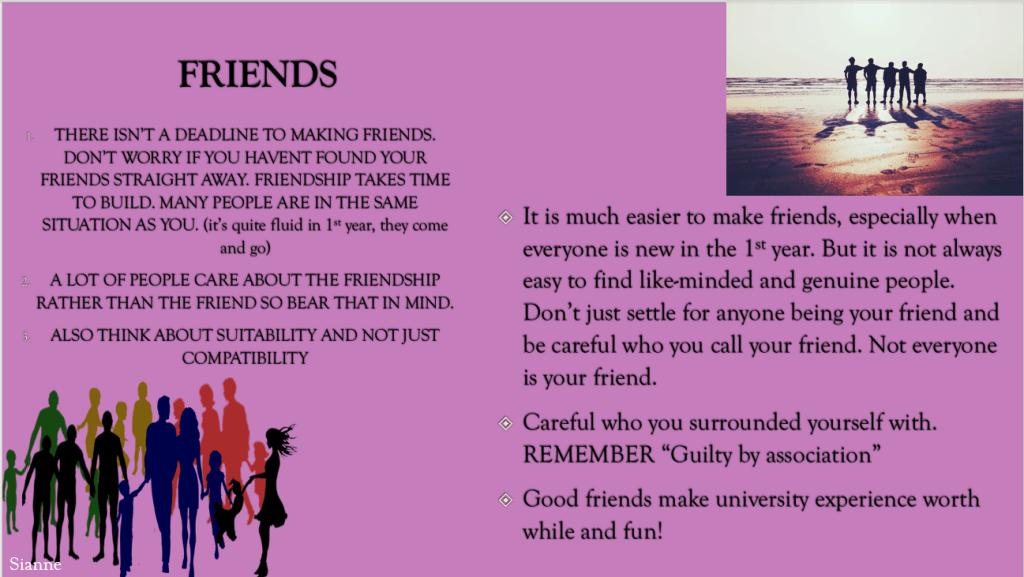
Friends are an important part of our life journey. Building friendships are a beautiful thing. But be mindful of the company you keep around. Just as people/friends make you, they can also ‘break’ you…
05.
BEING PRODUCTIVE and PROACTIVE
±Sorting out your workspace – Cluttered desk can lead to a cluttered mind. Clean and tidy your workspace. Also, change your work environment.
±Taking breaks- It will relax your brain and help you concentrate better.
±Eating healthy- Unsaturated oils, protein, fish, eggs, high fibre, potatoes, bread, rice, pasta, 5 portions of fruit and veg.

±Exercising – It can help boost your self-esteem, mood, sleep quality and energy and physically strengthen you.
±Making a timetable- Planning what you’re going to focus on can help organize your mind and help achieve what you set out to do.
±Using productivity apps – Trello, Evernote, myHomework student planner.
±Be active in extracurricular activities.

 Transparency Talks Truth
Excellent article hun, keep up the Godly work. A lot will benefit from this, keep inspiring, keep shining and congratulations again, many many more successessss beautiful.. 🙏🏾🙏🏾
LikeLiked by 1 person